
March 15, 2026 · Behind the Scenes · Lagos, Nigeria
Inside the Studio: Adokiye's New Album Takes Shape
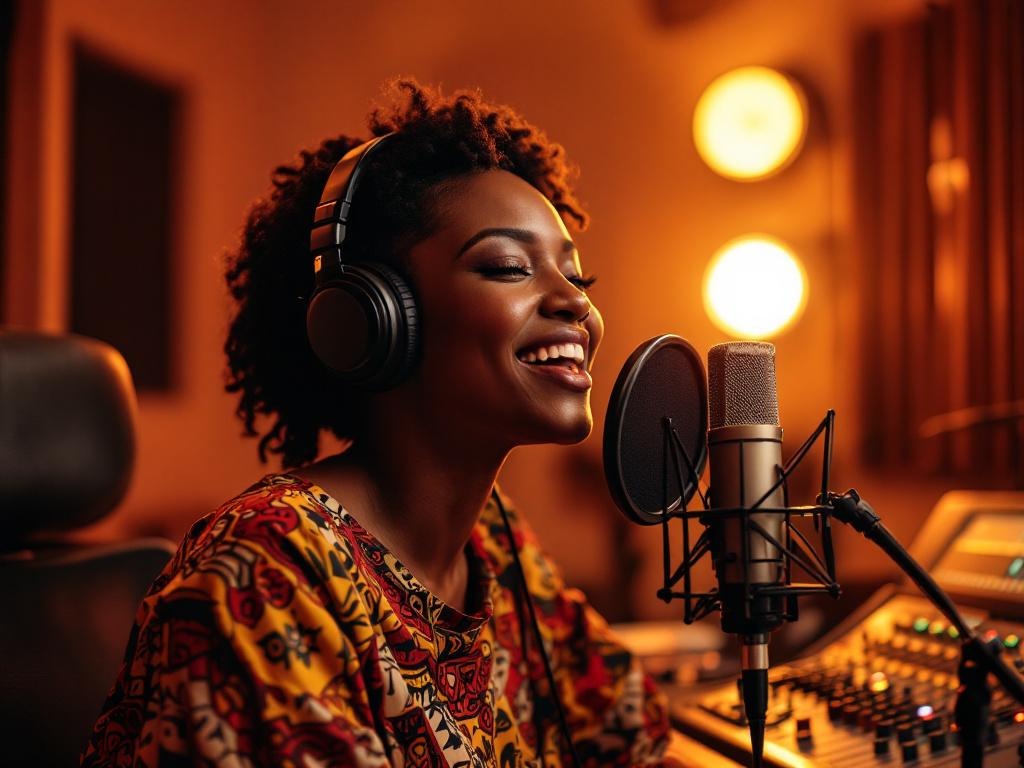
The studio is dimly lit. A single desk lamp casts a warm glow over a mixing console crowded with handwritten notes, empty coffee cups, and a small photograph of a village in Imo State. In the vocal booth, Adokiye adjusts her headphones and closes her eyes. The engineer hits record. What follows is a vocal performance so raw, so deeply rooted in something ancient and yet utterly modern, that everyone in the control room stops what they're doing and listens.
This is how music gets made in Adokiye's world — not through algorithms or trend-chasing, but through moments of pure, unfiltered expression that connect the artist to her roots and push the boundaries of what Afro-fusion can be. After months of writing, experimenting, and collaborating with musicians from across the African continent, Adokiye's new album is taking shape, and the early indications suggest it will be her most powerful and ambitious work to date.
The Vision: A Pan-African Sound
Unlike her previous releases, which drew primarily from Nigerian musical traditions, the new album deliberately reaches across the continent for inspiration. Adokiye spent three months traveling to recording studios in Accra, Johannesburg, and Addis Ababa, working with local musicians and absorbing the distinct musical languages of each region.
"I realized that Afro-fusion, the way I've been doing it, was really Naija-fusion," Adokiye explains during a break between recording sessions. "My music was rooted in Nigerian sounds — highlife, juju, gospel. And I love that. But Africa is so much bigger than one country. I wanted this album to reflect the full breadth of African music, the connections between our traditions, the things that make us one people even when we speak different languages."
The result is a collection of 14 tracks that weave together an extraordinary range of influences. There are songs built on the mbira patterns of Zimbabwe, tracks that incorporate the hypnotic rhythms of Ethiopian jazz, and at least one song that blends South African amapiano bass with traditional Igbo call-and-response vocals in a way that shouldn't work on paper but somehow feels inevitable when you hear it.
Collaboration as Philosophy
Adokiye's approach to collaboration on this album has been radically open. Rather than arriving at studios with finished songs and asking musicians to play predetermined parts, she brought concepts, emotions, and stories — then let the creative process unfold organically. Some of the album's strongest moments emerged from jam sessions that lasted hours, with musicians building on each other's ideas in real time.
"In Accra, I worked with a kora player named Kwame who had never heard my music before," she recalls. "I played him a melody I'd been working on, and he started improvising over it. Within twenty minutes, we had written a song together that felt like it had always existed. That's the magic of African music — it's communal by nature. It doesn't belong to one person."
The album features contributions from over 30 musicians across six countries. Notable collaborators include a Grammy-nominated producer from Lagos, a legendary highlife guitarist who came out of retirement specifically for the project, and a children's choir from the ADOCHANGE school program whose voices appear on three tracks.
Technology Meets Tradition
One of the most innovative aspects of the recording process has been the integration of traditional acoustic instruments with cutting-edge production technology. The album's primary producer has developed a technique for processing acoustic African instruments through custom-built effects chains that preserve their organic character while adding spatial depth and electronic texture.
"We're not trying to make traditional instruments sound electronic, and we're not trying to make electronic sounds feel organic," the producer explains. "We're finding the space where those two worlds naturally overlap. When you run a talking drum through a granular synthesizer, you get something that's neither traditional nor electronic — it's something entirely new. It's the future of African music."
The studio setup itself reflects this philosophy. Alongside state-of-the-art digital audio workstations and synthesizers, the recording space contains a collection of traditional instruments sourced from markets and workshops across West Africa: udu drums from Igbo potters, shekere gourds from Yoruba craftspeople, and a set of hand-forged ogene bells that produce a sound so pure it requires almost no electronic processing.
Lyrics That Matter
While the sonic palette of the album is its most immediately striking feature, Adokiye insists that the lyrics are where the album's true power lies. Songs address themes ranging from the personal — love, loss, identity, displacement — to the political, including tracks about environmental degradation in the Niger Delta, the resilience of African women, and the tension between tradition and modernity that defines contemporary African life.
Several songs are written in multiple languages, sometimes switching between English, Igbo, and Pidgin within a single verse. "Language is music," Adokiye says. "Each language has its own melody, its own rhythm. When I switch from English to Igbo in a song, it's not just a lyrical choice — it's a musical one. The song literally changes key."
One track in particular has been generating buzz among the small circle of people who have heard early mixes. Described as a seven-minute epic that builds from a solo vocal and hand drum into a full orchestral arrangement, the song tells the story of Adokiye's grandmother — a traditional healer and storyteller whose influence runs through everything the artist creates.
The Road Ahead
The album is expected to be completed by mid-2026, with a release planned for the fourth quarter. Adokiye has hinted that the rollout will be unconventional — possibly including a series of intimate listening events in African cities before the album becomes available on global streaming platforms.
"This music was made in Africa, inspired by Africa, and performed by African musicians," she says. "It should be heard in Africa first. The world can wait a little while."
In the meantime, fans can catch previews of the new material at the upcoming Lagos Homecoming Concert on June 14, where Adokiye will debut three tracks from the album in a live setting for the first time. Follow @adokiye on Instagram for updates on the album, the concert, and everything in between.